Physical Skill Intelligence
Composable skill contracts—preconditions, effects, recovery—so physical behaviours can be versioned and reused.
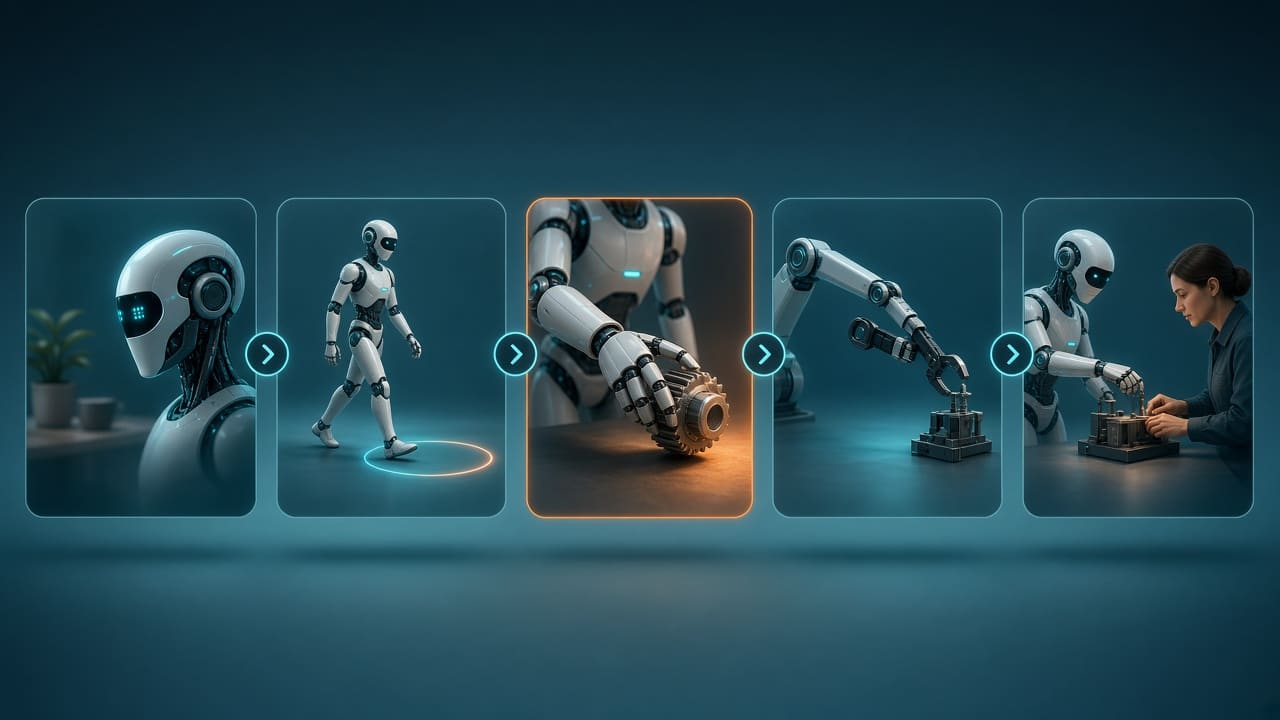
Skill libraries and composition—not the hand hardware and not the mission graph.
Useful robots do not win by excelling at one trick. They need a chain: see, sense, understand, move, touch, hold, manipulate, use tools, apply force, transform, transfer, and collaborate.
This program treats that chain as a research product—defining skill interfaces, evaluation, and transfer so progress in perception, dexterity, and teaching can compound instead of staying siloed.
It is the connective tissue between Spatial AI, Dexterous Robotics, Human Behaviour into Machines, and Autonomous Physical Work.
Skills are the reusable atoms of physical work: parameterised behaviours with preconditions, effects, and recovery. Depth means skill graphs that compose and transfer in simulation first, with partner cells confirming hardware transfer when a library is ready to promote.
Scope: This program owns skill interfaces and composition: how behaviours are packaged, evaluated, and chained. Dexterous Robotics supplies contact primitives; Human Behaviour into Machines supplies teaching pipelines; Autonomous Physical Work schedules skills into missions; Spatial AI provides where skills may run.
Durable layers of the program.
Skill contracts and evaluation harnesses—so one link can improve without rewriting the hand, the map, or the mission executive.
- Skill contracts
- Preconditions and effects
- Recovery behaviours
- Skill composition graphs
- Parameterised primitives
- Evaluation harnesses
- Versioned skill libraries
- Transfer across platforms
- Sim-to-partner promotion gates
- Interfaces to missions and teaching
Composable skills with contracts, not opaque blobs.
Physical Skill Intelligence studies how to represent, learn, and schedule skills so robots can assemble longer tasks. Day-to-day research is simulation- and dataset-centric (Isaac Lab and related), with hierarchical RL, behaviour trees, and modern policy classes evaluated against simpler baselines before any partner hardware booking.
Every skill carries a contract: what must be true to start, what success looks like, and what recovery looks like when contact or perception fails.
Algorithms we study and implement
- Skill / options frameworks and hierarchical policies for long-horizon tasks
- Behaviour trees and hierarchical FSMs as interpretable skill schedulers
- Imitation and residual learning for skill refinement from demos
- Diffusion-policy / action-chunking style sequence models evaluated against simpler baselines
- Parameterised primitives (approach, grasp, insert) with Bayesian or bandit-style tuning
- Curriculum and domain randomisation schedules tied to skill failure modes
Things we measure
- Skill success rate and recovery rate under declared perturbations
- Transfer across objects and workcells with minimal re-teaching
- Composition depth: how many skills chain before failure probability collapses
- Sample complexity to reach a target success threshold
- Interpretability: can an engineer read the skill graph and predict behaviour?
A skill is real when it composes twice in sim—and once more with a partner if needed.
Single-task success in simulation is necessary but not sufficient. We look for reuse across objects and scenes in sim, then schedule partner validation when product promotion requires it.
- Skill cards with preconditions, success metrics, and known failure modes
- Composition trials that reuse skills without retraining everything
- Baseline comparisons (scripted primitive vs. learned skill)
- Versioned skill artefacts with dataset hashes and training configs
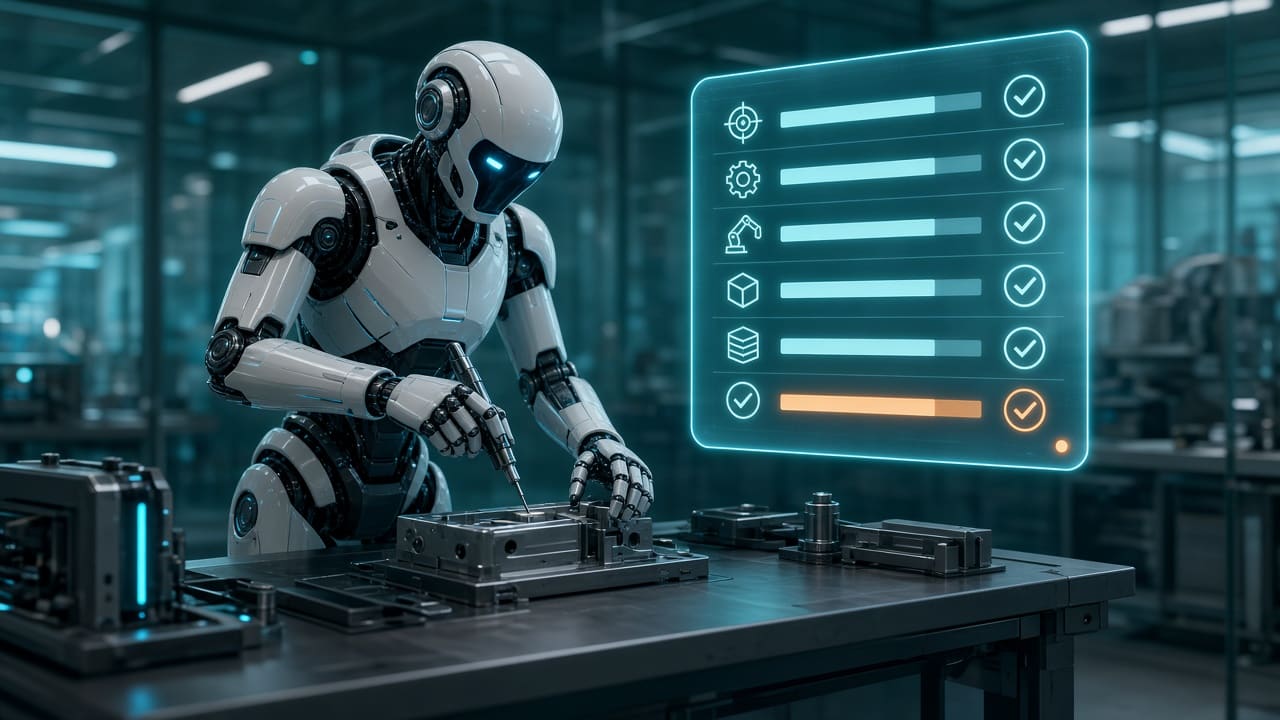
- Promotion checklist into RoboWorks production libraries
An open field, not a closed stack.
Skill libraries, behaviour trees, and robot learning platforms all claim parts of this chain. We focus on interoperable skills that survive product constraints.
Adjacent work
- Robot skill-library vendors
- Industrial application kits
- Academic manipulation curricula
- Foundation-model robotics stacks
Partners and complements
- ROS 2
- NVIDIA Isaac
- RoboWorks
- AgentFlow
- Dexterous Robotics
- Spatial AI
- Human Behaviour into Machines
A path that compounds over time.
From isolated demos to evaluated skill packs that can be composed, versioned, and shipped.
- Shared skill interfaces across RoboWorks platforms
- Evaluation harnesses for contact and collaboration skills
- Transfer of taught skills across embodiments
- Composition into multi-step jobs
- Product packaging for partners and OEMs