Dexterous Robotics
Contact at the hand—grasp, force, tactile sensing, and tool use in simulation and partner cells.
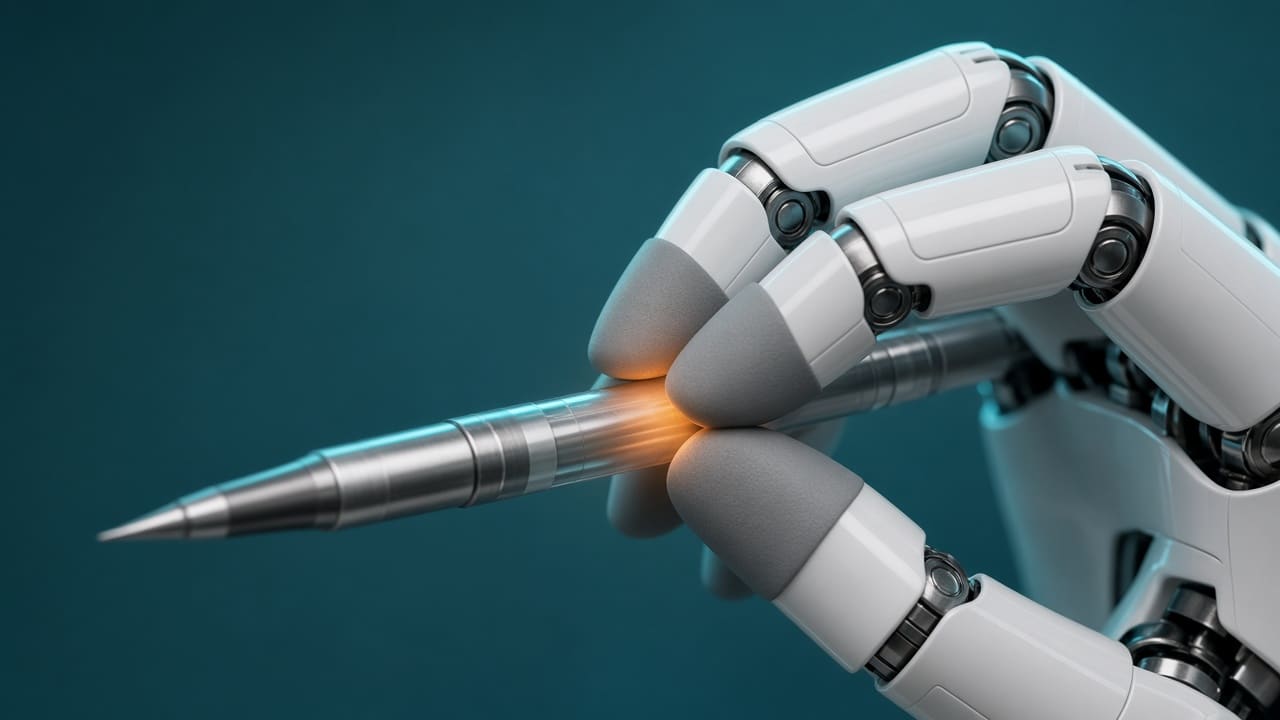
The contact layer—how the hand meets the world.
Moving through a space is only half the problem. Real work needs grasping, seating parts, using tools, and coordinating two hands under uncertainty.
This program focuses on dexterous manipulation: grasp planning, force/tactile models, bimanual coordination, and tool use. Simulation (Isaac Lab and related) is our default laboratory; transfer to hardware happens with robotics partners when a milestone needs real contact.
It underpins RoboWorks companions and any future product that must handle objects people handle every day.
Dexterity research is contact science: friction cones, tactile models, and controllers that remain stable when the grasp model is wrong. We go deeper than “can it pick up the cup?” in simulation, then continue with partner hardware sessions for slip, regrasp, and tool-use confirmation.
Scope: This program owns end-effector contact: grasping, slip, force, tactile skins, and bimanual tool use. Skill libraries and composition live in Physical Skill Intelligence; human teaching methods in Human Behaviour into Machines; whole-body grounding in Embodied Human Intelligence.
Durable layers of the program.
Sensing, planning, and control for contact—force without a skill graph, and without pretending this is the whole robot stack.
- Tactile sensing
- Force / torque sensing
- Grasp planning
- Bimanual manipulation
- Tool use
- Slip detection
- In-hand reorientation
- Contact modelling
- Sim-to-real for hands
- Safety-limited force control
Contact-rich manipulation with measurable grasp quality.
We combine classical grasp metrics and impedance control with learned tactile features in simulation. Dense force/tactile feedback on real skins is obtained through partner setups when a study needs it—simulation remains the everyday research environment.
Bimanual and tool-use tasks are treated as sequenced skills with explicit failure recovery—not one monolithic policy.
Algorithms we study and implement
- Grasp sampling and quality metrics in the Ferrari–Canny / wrench-space tradition
- Impedance and admittance control for compliant seating and insertion
- Tactile slip detection and in-hand reorientation controllers
- Bimanual coordination via shared object frames and timed primitives
- Learning-from-demonstration and residual RL for contact corrections
- Sim-to-real for hands: domain randomisation on friction, mass, and sensor noise
Things we measure
- Grasp success under object variability and pose noise
- Peak and average contact force during seating tasks
- Slip events detected vs. slips that became drops
- Cycle time and recovery count for tool-use sequences
- Tactile / F-T sensor SNR and calibration drift over sessions
Hands prove themselves in sim failure suites—and partner contact trials when scheduled.
We keep the simulated drops and the partner-logged ones. Success rate without a failure taxonomy is not scientific exploration—it is a demo reel.
- Object set and pose noise model declared before quoting success rates
- Force traces for insertion / seating with limit violations highlighted
- Comparison of vision-only vs. tactile-augmented grasps on the same set
- Tool-use trials with intentional perturbations (slip, mis-grasp)
- Skill packaging rules for promotion into RoboWorks libraries
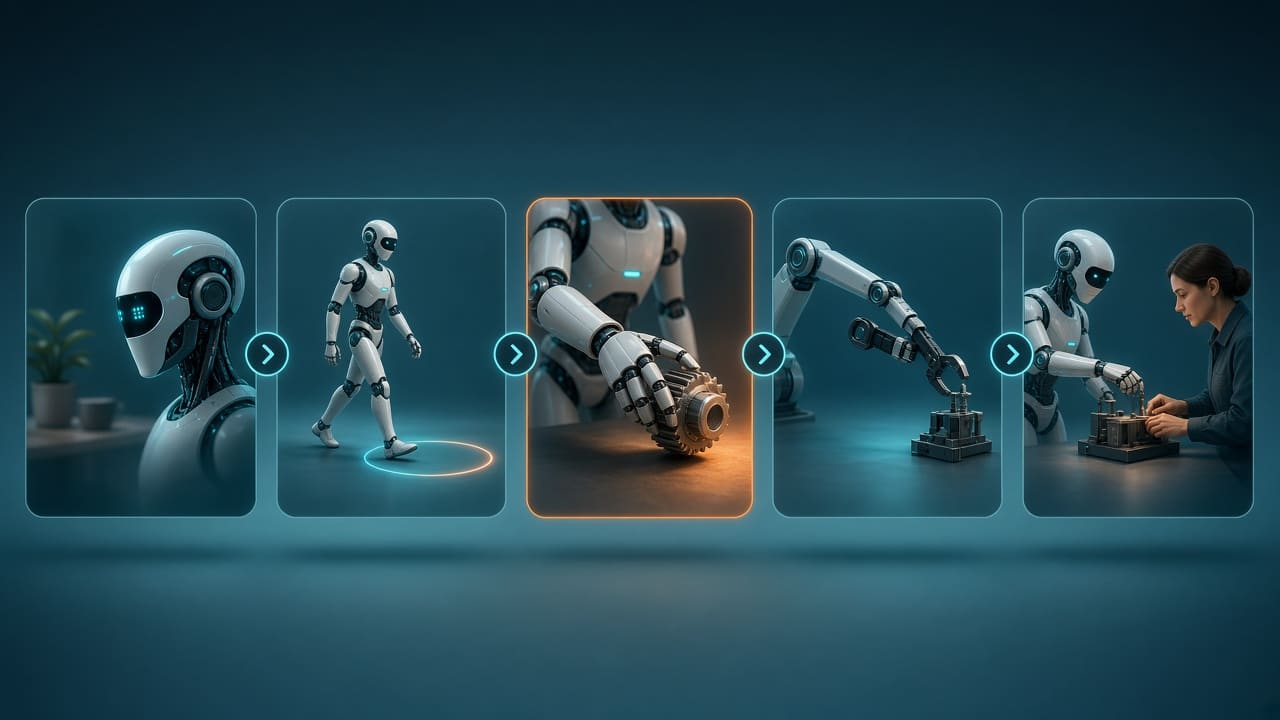
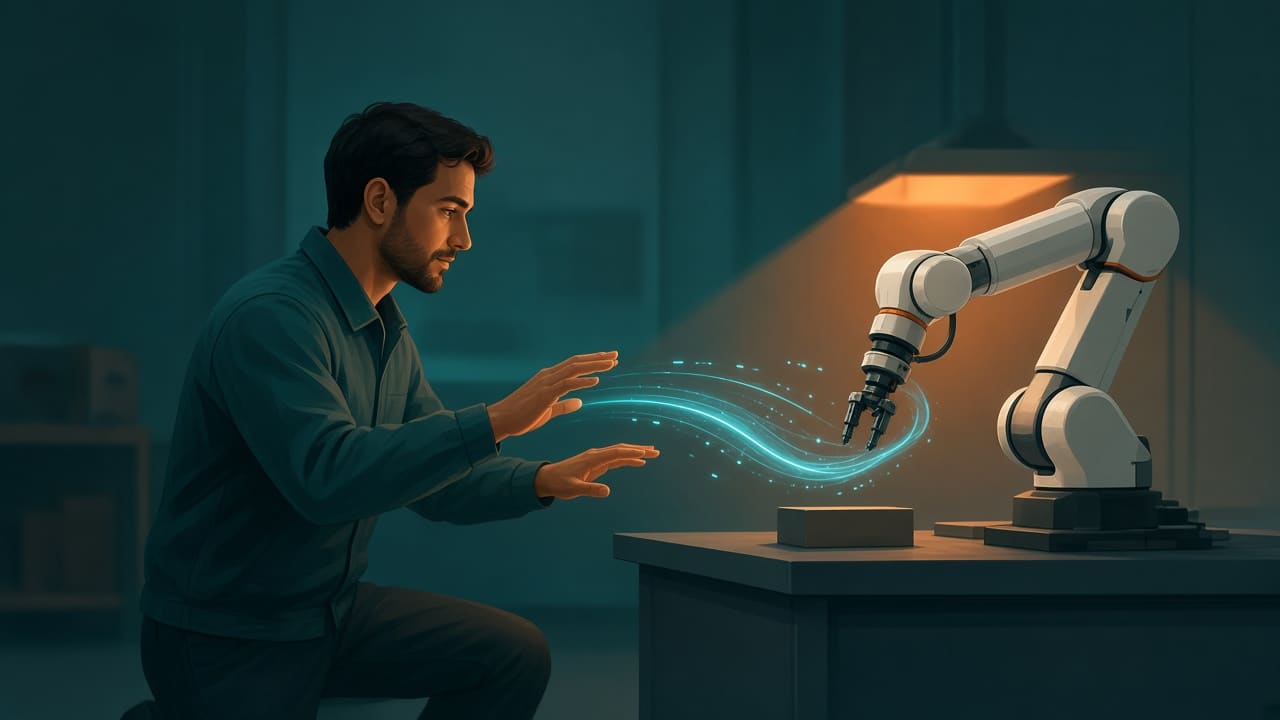
An open field, not a closed stack.
Dexterous hands, tactile skins, and manipulation research are advancing quickly. We plug into that ecosystem through simulation and partner cells, then productise what holds up toward RoboWorks.
Adjacent work
- Dexterous-hand hardware vendors
- Tactile sensing companies
- Manipulation research labs
- Industrial robot OEMs
- Humanoid manipulation teams
Partners and complements
- ROS 2 manipulation stacks
- NVIDIA Isaac
- Simulation and Isaac Lab
- RoboWorks
- Human Behaviour into Machines
- Physical Skill Intelligence
A path that compounds over time.
From reliable grasps to tool use and bimanual work that can be taught, reused, and verified.
- Stable grasping across everyday objects
- Force-aware seating and assembly motions
- Tool use with slip and failure recovery
- Bimanual coordination for longer tasks
- Integration into RoboWorks skill libraries