
Cloud Engineering & DevOps
Akhila Labs architects future-proof cloud systems. We transform monolithic apps into cloud-native microservices, build internal developer platforms for rapid deployment, and optimize cloud costs through rigorous FinOps. From AWS to Azure to GCP—we build once, deploy anywhere.
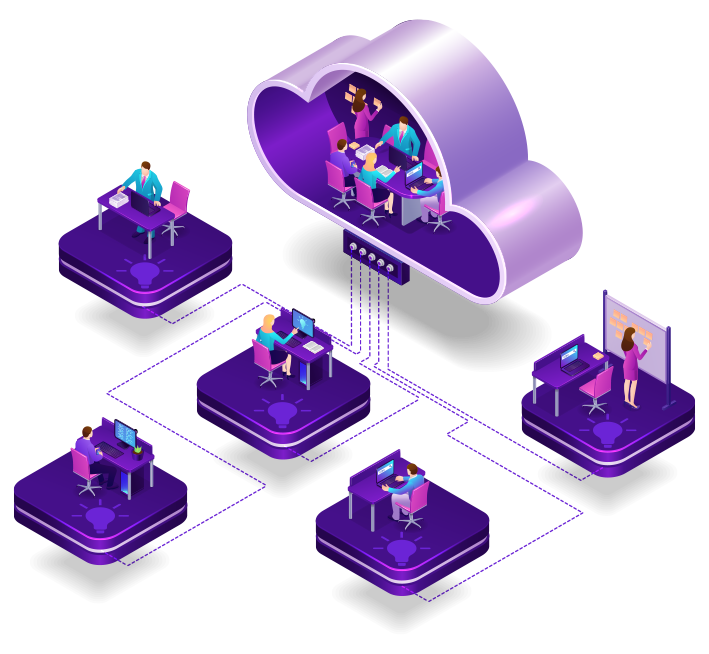
Cloud-native expertise: microservices, Kubernetes, serverless, event-driven architectures
FinOps mastery: reduce cloud costs 30-40% through intelligent tagging, cost allocation, auto-scaling
Platform Engineering: build internal developer platforms (IDPs) that accelerate time-to-market
Multi-cloud architecture: portable deployments across AWS, Azure, GCP without lock-in
Security & compliance: HIPAA, GDPR, PCI-DSS, SOC2 built into architecture
Proven at scale: managed cloud infrastructure for startups to enterprises (100+ microservices, 1M+ req/sec)
OVERVIEW
CLOUD-NATIVE ENGINEERING
- Elastic scalability: automatically scale from 0 to 1M+ requests/second
Rapid deployment: deploy code changes in minutes without downtime
Cost optimization: pay only for resources used, with automated scaling
High availability: resilience across availability zones and regions
Developer velocity: self-service infrastructure, reduced operational burden
However, transitioning to cloud-native is not a simple “lift and shift.” It requires rethinking application architecture, deployment pipelines, monitoring, and cost management.


Cloud-Native Application Architecture
Connectivity Optimized for Robustness, Security, and UX
- We decompose monolithic applications into loosely-coupled microservices. Each service:Owns its data (no shared databases across services)
Scales independently based on demand
Deploys independently (no coordinated releases)
Can be rewritten/replaced without affecting others
Containerization & Orchestration
Docker containers package applications with all dependencies. Kubernetes orchestrates containers at scale
- Automatic scaling (horizontal and vertical)
Self-healing (restart failed containers)
Zero-downtime rolling updates
Multi-cloud portability


Infrastructure as Code (IaC)
All infrastructure defined in code (Terraform, CloudFormation, Ansible). Benefits:
- Version control for infrastructure
Reproducible environments (dev, test, prod identical)
Automated provisioning and teardown
Cost auditing (code review infrastructure changes)
CI/CD Pipelines & GitOps
Automated testing and deployment. GitOps workflow
- Developer commits code → tests run automatically → deployed to staging → approval → production deployment
Zero-downtime rolling updates (blue/green, canary deployments)
Automatic rollback on failures
Audit trail (every deployment tracked in git)


FinOps & Cost Optimization
Cloud costs spiral when unmanaged. We implement
- Cost allocation (tagging, chargeback models)
Waste identification and elimination
Spot instance orchestration (80% savings on compute)
Reserved instances and savings plans optimization
Unit economics (cost per transaction, cost per user)
Observability & Monitoring
"You can't optimize what you can't measure." We implement
- Metrics: Prometheus, CloudWatch
Logs: ELK stack, CloudWatch Logs
Traces: distributed tracing for request flow visualization
Alerts: intelligent alerting preventing alert fatigue
Dashboards: real-time visibility into system health


Serverless & Event-Driven Architecture
For certain workloads, serverless (Lambda, Functions, Cloud Run) eliminates infrastructure management
- Auto-scaling to zero (no idle costs)
Pay-per-execution pricing
Event-driven processing (respond to S3 uploads, queue messages, etc.)
Rapid deployment (no server provisioning)
DIFFERENTIATORSe
KEY DIFFERENTIATORS
True Cloud-Native Expertise
Not just moving apps to the cloud—we redesign for cloud-native principles. We understand when to use microservices vs. monolith, when serverless makes sense, when Kubernetes is overkill.

Platform Engineering Excellence
We don’t just build infrastructure; we build Internal Developer Platforms (IDPs). Developers self-serve—deploy, scale, monitor—without DevOps bottlenecks.
Ahmedabad Advantage
We bridge embedded systems and cloud. Unlike pure-cloud consultants, we understand hardware constraints, enabling true edge-cloud coordination.
FinOps Obsession
Most teams focus on features; we balance features with cost. We’ve helped clients reduce cloud bills 30-40% without sacrificing performance or reliability.
Security & Compliance by Default
HIPAA, GDPR, PCI-DSS, SOC2 built into architecture, not added later. We use IAM properly, network segmentation, encryption, audit logging from day one.
Multi-Cloud Mastery
AWS dominates, but Azure has advantages for enterprises, GCP excels at data/ML. We architect for portability—avoid vendor lock-in, enable future flexibility.
Production Hardening Experience
We’ve managed systems handling 1M+ requests/second, storing exabytes of data, running on 1000+ nodes. We know what breaks at scale.
Technical Capabilities Deep Dive
Containerization & Orchestration
- Docker: image building, registry management, best practices
- Kubernetes: EKS (AWS), AKS (Azure), GKE (GCP), on-premises
- Helm: package management for Kubernetes
- Service mesh: Istio for advanced traffic management
Infrastructure as Code
- Terraform: cloud-agnostic IaC
- AWS CloudFormation: AWS-native IaC
- Ansible: configuration management
- Pulumi: IaC in programming languages
CI/CD & GitOps
- Jenkins: traditional CI/CD
- GitLab CI, GitHub Actions: modern CI/CD in git
- ArgoCD: GitOps for Kubernetes deployments
- SonarQube: code quality and security scanning
Monitoring & Observability
- Metrics: Prometheus, CloudWatch, Azure Monitor, Google Cloud Monitoring
- Logs: ELK stack, Splunk, CloudWatch Logs, Datadog
- Traces: Jaeger, AWS X-Ray, Azure Application Insights
- Alerts: alertmanager, PagerDuty integration
Data & Analytics
- Databases: PostgreSQL, MySQL, MongoDB, DynamoDB, Cosmos DB
- Data warehouses: Snowflake, Redshift, BigQuery
- Message queues: Kafka, RabbitMQ, AWS SQS/SNS
- Stream processing: Apache Flink, Kafka Streams, AWS Kinesis
Security & Compliance
- IAM: role-based access control, least privilege
- Network: VPC, security groups, network policies
- Encryption: TLS/mTLS, encryption at rest
- Secrets management: HashiCorp Vault, AWS Secrets Manager
- Compliance: automated compliance checking, audit logging
TECHNOLOGY STACK

Cloud Platforms
Amazon Web Services (AWS)
Microsoft Azure
Google Cloud Platform (GCP)

Containerization
Docker, Docker Compose
Kubernetes (EKS, AKS, GKE)
Helm, Docker Registry

Infrastructure as Code
Terraform, CloudFormation, Ansible
Pulumi (IaC in code)

CI/CD & Deployment
GitHub Actions, GitLab CI, Jenkins
ArgoCD, CircleCI
Spinnaker (CD)

Monitoring & Logging
Prometheus, Grafana
ELK Stack (Elasticsearch, Logstash, Kibana)
Datadog, New Relic
CloudWatch, Azure Monitor

Databases & Data
PostgreSQL, MySQL, MongoDB
DynamoDB, Cosmos DB
Snowflake, Redshift, BigQuery
Apache Kafka
INDUSTRIES SERVED

FinTech
Applications:High-freq trading, payment gateways, fraud detection
Key Requirements:Sub-100ms latency, 99.99% uptime, PCI-DSS compliance

SaaS
Applications:Multi-tenant platforms, real-time collaboration
Key Requirements:Auto-scaling, cost per customer metrics, rapid feature deployment

Healthcare
Applications:EHR systems, telemedicine, medical imaging
Key Requirements:HIPAA compliance, data residency, secure multi-tenant isolation

Media & Streaming
Applications:Video delivery, live streaming, analytics
Key Requirements:Petabyte-scale storage, global CDN, sub-second latency

E-Commerce
Applications:Checkout, recommendations, inventory, analytics
Key Requirements:Black Friday scaling (1000x spikes), <500ms latency

IoT & Edge
Applications:Device data ingestion, fleet management, analytics
Key Requirements:Millions of devices, real-time processing, edge-cloud coordination
CASE STUDY EXAMPLES
Akhila Labs supports a wide spectrum of healthcare and wellness applications:
Model 1: Cloud Migration Factory
Best For: Organizations moving legacy workloads to cloud
Includes: Assessment, migration planning, lift-shift, refactoring, training
Duration: 6–18 months depending on scope
Cost Range:$500K–$2M
Model 2: DevOps Transformation
Best For: Organizations establishing DevOps culture and tooling
Includes: Pipeline setup, Infrastructure as Code, monitoring, team training
Duration: 3–6 months
Cost Range: $150K–$400K
Model 3: Dedicated Cloud Engineering Team
Best For: Long-term cloud operations and innovation
Includes: 2–4 cloud engineers, 24/7 support, continuous optimization
Duration: 12+ months
Cost Range: $80K–$150K per engineer/month
Model 4: Platform Engineering (IDP)
Best For:Organizations building internal developer platforms
Includes: IDP design, developer experience, self-service infrastructure
Duration: 3–6 months
Cost Range: $200K–$500K
Model 5: FinOps Optimization
Best For: Organizations with large cloud bills seeking cost reduction
Includes: Cost analysis, tagging strategy, optimization, governance
Duration:8–12 weeks
Cost Range: $50K–$150K
INDUSTRIES SERVED
Frequently Asked Questions
At Akhila Labs, embedded engineering is the foundation of everything we build. We go beyond writing firmware that runs on hardware—we engineer systems that extract
maximum performance, reliability, and efficiency from the silicon itself.
Should we use Kubernetes or serverless?
Kubernetes: full control, complex applications, cost-sensitive (long-running). Serverless: rapid scaling, event-driven, pay-per-execution. Many use both (Kubernetes for stateful, Lambda for functions).
How do we reduce cloud costs?
FinOps: tag all resources, analyze by cost center, eliminate idle resources, use Spot instances (80% savings), optimize database queries, right-size instances. We often find 30-40% savings.
What's a realistic cloud migration timeline?
Simple: 3-4 months. Complex with compliance: 12+ months. Database size, integration complexity, regulatory requirements all affect duration. We provide detailed estimates after assessment.
How do we handle data residency (GDPR, local regulations)?
We pin data to specific geographic regions using cloud provider features. EU data in EU regions, India data in India, etc. Unified management plane can still be global.
Can we avoid vendor lock-in?
Partially. Use Kubernetes (portable across clouds), containers (portable), IaC (portable). Some services are cloud-specific (Lambda, DynamoDB). We design for portability without sacrificing cloud benefits.
How do we ensure security in cloud?
IAM (least privilege), network segmentation (VPC), encryption (TLS, at-rest), secrets management (Vault), audit logging, compliance automation. Security is a process, not a checkbox.
What about multi-region and disaster recovery?
Active-active in multiple regions for high availability. Database replication with failover. DNS routing to healthy region. Test DR plans quarterly. Most fail in the test—fix issues before real disaster.
How long does a CI/CD pipeline typically take to set up?
Simple: 2-4 weeks. Complex with security scanning, compliance: 6-8 weeks. Most time spent on testing and approval workflows, not tooling.
What's included in 24/7 managed cloud services?
Monitoring, incident response, patching, scaling decisions, cost optimization, security updates. We alert on issues, respond in <15 minutes, resolve in <1 hour SLA.
Case Study 3: Industrial Vibration Sensor – Predictive Maintenance
Challenge A manufacturing equipment company needed vibration sensors for predictive maintenance across industrial facilities. The solution required a rugged design, reliable wireless mesh networking, and battery-powered operation with peak power consumption under 100mA. Solution High-Precision Sensing: 3-axis accelerometer (±16G range) for detailed vibration analysis. Edge AI Processing: STM32L476 MCU running anomaly detection algorithms locally. Mesh […]
Case Study 2: Medical-Grade Wearable ECG Monitor – FDA 510(k) Cleared
Challenge A healthcare startup needed to develop an ECG wearable that met FDA Class II requirements, using medical-grade components and biocompatible materials. The device also required ultra-low power consumption (under 2mA average) while maintaining clinical-grade accuracy. Solution Medical-Grade Components: Selected components meeting AEC-Q200 equivalent standards. Biocompatible Design: Silicone enclosure and electrode materials safe for prolonged […]



Subscribe to the Akhila Labs Newsletter
Get the latest insights on AI, IoT systems, embedded engineering, and product innovation — straight to your inbox.
Join our community to receive updates on new solutions, case studies, and exclusive announcements.