
In-Body Intelligence
Tissue-adjacent sensing form factors—models, partner datasets, and medical–health collaborations for devices that live close to the body.
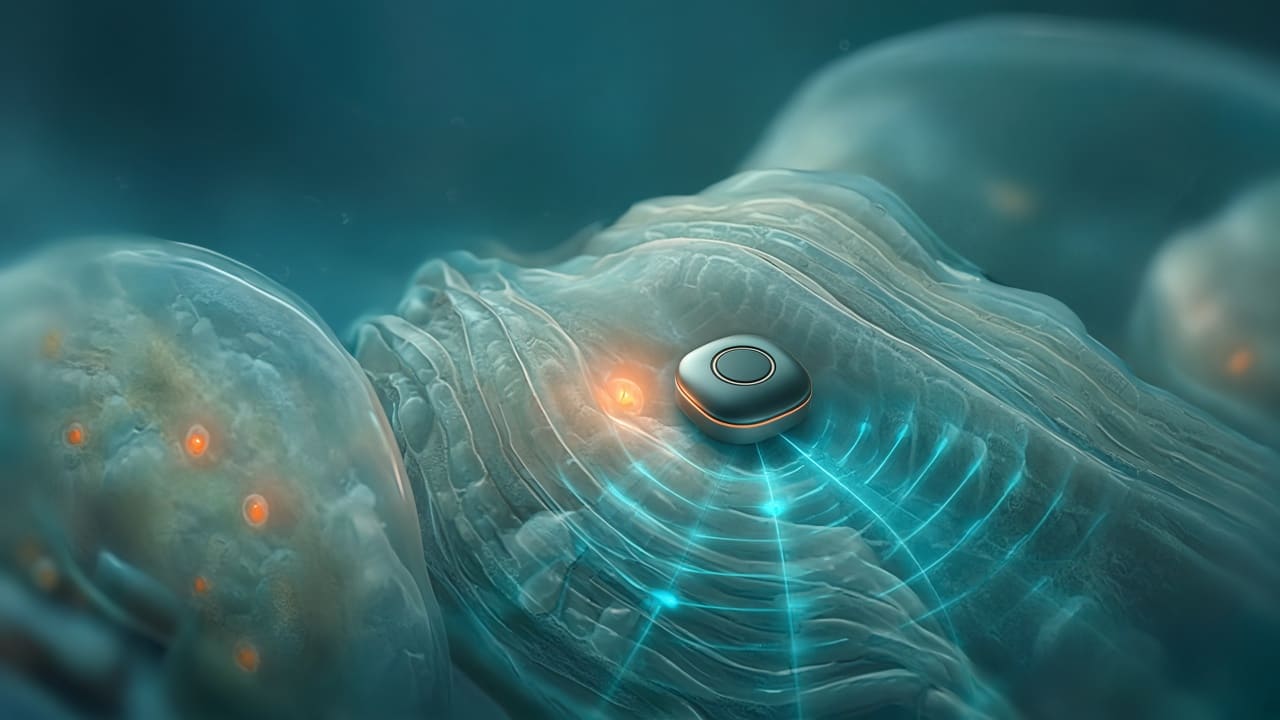
The sensing interface—not the care loop, not the battery.
Most health and wellness products still sit outside the body. The next wave of useful insight will come from systems that can listen closer—implant-adjacent packages, ingestible nodes, and ultra-small bioelectronic interfaces that remain safe, wireless, and practical for real people.
This program explores how sensing, power, and computation can share the same tiny footprint. Much of our day-to-day work is modelling, firmware analytics, and biosignal data science with medical and health partners who bring clinical context and access to characterised hardware or phantoms when a study needs them.
The aim is not a single device. It is a durable research path that can feed WearIQ, CareConnect, and medical-edge products as the technology matures.
At research depth, that means treating the body as a constrained RF, thermal, and electrochemical environment. We run path-loss, leakage, and duty-cycle models first, then continue wet-lab or phantom measurements with medical and health partners as the study design matures.
Scope: This program owns the tissue-side interface: packaging, wireless readout, and sensing at the body edge. Power budgets belong to Energy-Harvesting Intelligence; on-device decisions and alerts belong to Closed-Loop Human Intelligence.
Durable layers of the program.
Layers for the tissue interface itself—so form factor, sensing, and wireless readout can mature without owning the full care stack.
- Miniaturized bioelectronics
- Wireless sensing
- Wireless power
- Battery-free electronics
- Bioelectric sensing
- Tissue interfaces
- Ingestible electronics
- Minimally invasive packages
- Implant-adjacent systems
- Ultra-low-power computation
Close to tissue, every microjoule and microvolt matters.
In-body and implant-adjacent systems fail quietly: a millimetre of mis-packaging, a poorly conditioned front-end, or a link that works on the desk and dies against wet tissue. Our methods stack starts with signal integrity and power, then only adds on-node intelligence when the budget allows.
We separate acquisition models, recovery (denoising and sparse telemetry on partner or public traces), and decision (ultra-low-power classifiers) so each layer can be validated in software—and on partner phantoms or benches—before a full system is claimed.
Algorithms we study and implement
- Wavelet and band-limited denoising for PPG, ECG, EMG, and bioimpedance traces under motion artefact
- Adaptive thresholding and template matching for sparse event detection on-node
- Compressive sensing / event-driven sampling so wireless packets stay rare and informative
- Inductive and NFC-class power-transfer efficiency models with coil Q and misalignment sweeps
- Leakage and SAR-oriented envelopes that bound continuous and pulsed RF exposure
- TinyML-class inference (quantised nets, CMSIS-NN style kernels) only after the sensing chain is stable
Things we measure
- Front-end noise and CMRR from partner phantom or characterisation reports
- Cold-start and harvested-power survival under modelled intermittent coupling
- Link-budget sensitivity vs. tissue depth / orientation from RF models and partner tests
- Thermal rise envelopes under worst-case duty cycle (simulation + partner spot checks)
- Storage lifetime under realistic sensing intervals derived from logged or partner traces
Evidence we trust before we bridge to WearIQ or CareConnect.
Evidence here is engineering and analytics quality: reproducible pipelines, open methods, and partner-supervised studies when tissue or medical process access is part of the work—without inventing clinical outcomes.
- Documented models plus any partner phantom or ex-vivo link budgets—with study ownership named
- Power state machines with measured or partner-bench µA/µW draws where hardware exists
- Reproducible offline feature pipelines on public or partner biosignal sets before on-device classifiers
- Materials and encapsulation notes that separate simulation assumptions from partner lab results
- A clear hand-off: analytics / models → WearIQ or CareConnect interface definition
An open field, not a closed stack.
Universities, medical-device companies, and semiconductor groups are all active here. We treat that as an ecosystem—not a race to own every layer.
Adjacent work
- University bioelectronics labs
- Medical-device companies
- Bioelectronics startups
- Semiconductor and MEMS research groups
- Minimally invasive and implantable research institutions
Partners and complements
- Medical sensor companies
- Wireless-power specialists
- MEMS manufacturers
- Hospitals and clinical research partners
- Medical-device OEMs
- AL DeviceHub
- Wearable Intelligence
- Connected Care
A path that compounds over time.
Progress compounds: safer packages first, then batteryless sensing, then closed loops that can earn clinical trust.
- Tissue-safe packages and materials that can live near the body for longer windows
- Batteryless or hybrid-powered sensing nodes with reliable wireless readout
- Closed-loop bioelectric pathways that sense and respond with clear safety bounds
- Clinical-grade wireless links and validation paths
- Integration into WearIQ and CareConnect device families where the research is ready to ship