Closed-Loop Human Intelligence
Biosignal fusion and on-device decision design with medical–health partners—closing the human sensing loop safely.
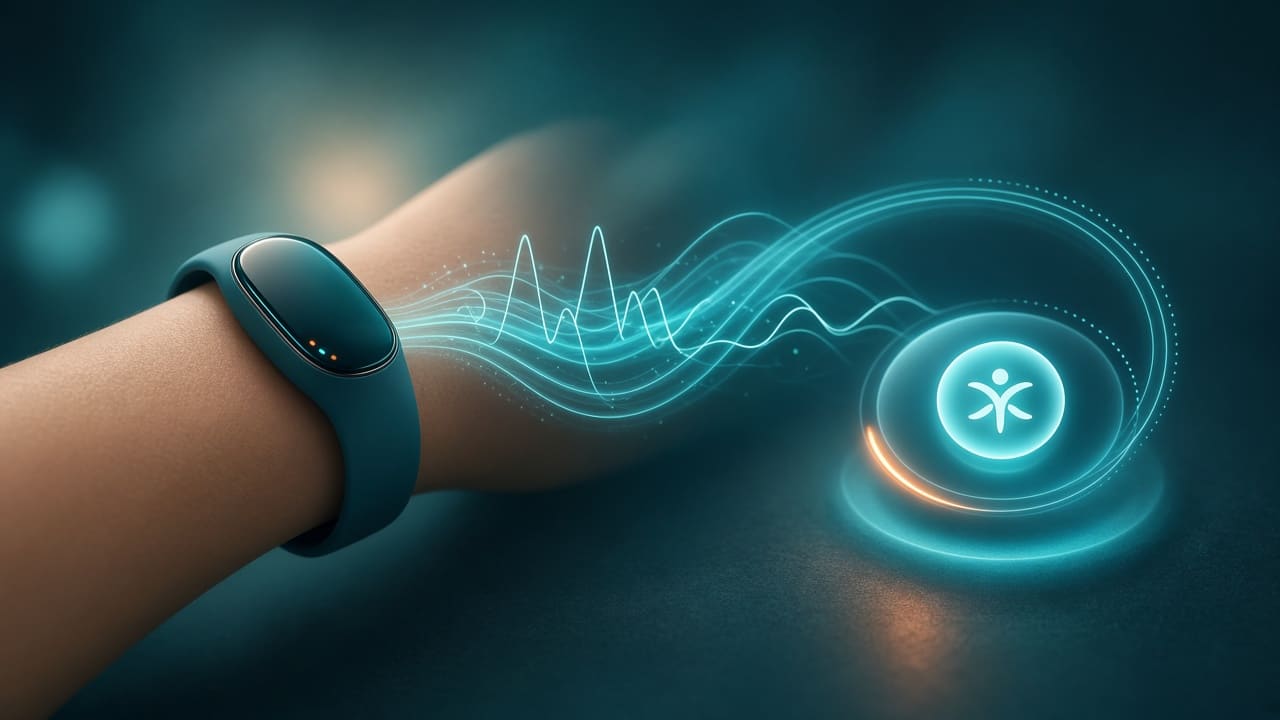
From biosignals to decisions—not the implant package and not the robot body.
Raw biosignals are not insights. People need systems that can fuse multimodal inputs, understand context, and respond—on the device when latency, privacy, or connectivity demand it.
This program explores closed-loop pathways: sensing stacks, on-device models, personalisation, and safe actuation or coaching. We design for the messy reality of daily life, not lab-only conditions.
The research bridges WearIQ, Connected Care, and any product that must turn human signals into timely, trustworthy action.
A closed loop is only as safe as its detectors, latency budget, and fallback. Our core work is multimodal fusion analytics and on-device model design with medical and health partners who provide labelled datasets and clinical review.
Scope: This program owns human physiological loops: estimate, gate, decide, escalate. Device form factors live in In-Body Intelligence; ambient power in Energy-Harvesting Intelligence. Robot embodiment and missions are separate robotics programs.
Durable layers of the program.
Sensing, fusion, understanding, and response for people—kept lean enough for edge wearables and care workflows.
- Multimodal biosensing
- On-device signal fusion
- Personalised models
- Context awareness
- Privacy-preserving inference
- Closed-loop feedback
- Coaching and actuation paths
- Edge ML runtimes
- Health-platform bridges
- Safety and escalation rules
Sense, estimate, decide, actuate—with latency you can explain.
Closed-loop human intelligence fuses biosignals and context into estimates, then policies that suggest or escalate within bounds. Day to day that means partner datasets, offline pipelines, and edge-model prototyping—with human override and clinical partners in the loop whenever decisions approach care pathways.
We keep the estimation layer (filters, HRV-style features, quality indices) separate from the policy layer so either can be swapped without rewriting the product shell.
Algorithms we study and implement
- Kalman and complementary filters for multimodal biosignal / IMU fusion
- Signal-quality indices that gate decisions when PPG/ECG confidence collapses
- HRV and related time/frequency features (e.g. RMSSD-style windows) as interpretable inputs
- Tiny classifiers and rule hybrids for on-device triage before cloud escalation
- Hysteresis and rate-limiters so loops do not chatter under noisy estimates
- Fallback FSMs: degrade to sensing-only or human alert when actuators or models disagree
Things we measure
- Decision latency from sample to alert on recorded or streamed partner traces
- False-alarm and miss rates on labelled partner or public datasets
- Behaviour under sensor dropout and motion artefact in replay studies
- Energy and thermal cost of continuous vs. duty-cycled loops in models
- Human override clarity reviewed with health-workflow partners
Loops earn trust with partner-reviewed failure stories, not only demos.
We document what happens when the loop is wrong—on datasets and with medical–health partners who can judge clinical relevance. That is the evidence collaborators should demand.
- Latency and accuracy reported together on the same evaluation set
- Explicit unsafe states listed with the designed response for each
- Ablation: estimator alone vs. full policy, so gains are attributable
- Human-factors check: can a non-expert understand what the loop is doing?
- Product bridge only after WearIQ / CareConnect safety review criteria are named
An open field, not a closed stack.
Consumer health, clinical digital therapeutics, and edge-AI vendors all touch this space. Complements matter as much as competitors.
Adjacent work
- Wearable AI platforms
- Digital therapeutics companies
- Clinical decision-support research
- Edge ML toolkit vendors
- Biosignal analytics startups
Partners and complements
- Apple Health / Google Health Connect
- Medical sensor partners
- WearIQ
- CareConnect
- AL DeviceHub
- Hospitals and research clinics
A path that compounds over time.
From reliable sensing windows to personalised loops that earn trust—and know when to escalate to a human.
- Robust multimodal sensing on wearable form factors
- On-device fusion with clear uncertainty estimates
- Personalised closed loops for coaching and alerts
- Clinical validation paths where required
- Product bridges into WearIQ and CareConnect experiences